Why Simcoe County & Muskoka Homeowners Trust Us With Retaining Wall Repair
See Your Price Before You Call
Get an instant online severity check with an estimated repair range before you ever pick up the phone.
Diagnosis-First Approach
We find the actual cause behind the damage, not just the fastest sale.
Fixes That Start With Water
Most wall failures start with water, so that's where we start too.
WSIB Insured & Fully Licensed
Full liability insurance and WSIB coverage on every job, no exceptions.
Trusted Local Network
We work with trusted contractors across Muskoka and Simcoe County to help get your wall repair done right.
Repair or Rebuild, Honestly Assessed
We tell you which one your specific wall actually needs.
Is Your Retaining Wall Actually a Problem?
If you're looking at a retaining wall that's leaning, cracking, or bulging, the first question isn't "how much will this cost" , it's "how serious is this, really." Some warning signs mean you have time to plan a repair properly. Others mean you should get someone out to look at it soon. We'd rather give you an honest read on which situation you're in than push every wall we see toward the most expensive fix.
We repair and rebuild retaining walls across Simcoe County and Muskoka , timber, concrete block, interlock, armour stone, and poured concrete. Before we talk about repair, it's worth understanding why walls fail in the first place, because that's what determines whether a wall needs a small fix or a full rebuild.
Why Retaining Walls Fail
Almost every retaining wall failure we see traces back to drainage. A retaining wall is designed to hold back soil, not water.
When water isn't managed properly , a downspout draining straight into the backfill, a slope directing runoff toward the wall, or soil that simply doesn't drain — it builds up behind the wall and creates hydrostatic pressure: the outward push of saturated soil and standing water against a structure that was never engineered to resist it.
That pressure gets worse every winter through freeze-thaw cycles. Water trapped behind the wall freezes and expands, pushing the wall outward slightly. It thaws, and the wall settles back , not quite all the way. Repeat that cycle for a few winters and small movements become a visible lean.
Add surcharge load — the extra weight of a driveway, building, or pool sitting above the wall — and the same drainage problem becomes considerably more serious, because there's more weight pushing down and more consequence if the wall lets go.
Common Warning Signs
Here's what each sign typically tells us, in order of how much urgency it usually deserves:
- Cracks or crumbling: Often the earliest sign, especially in concrete block or poured concrete. Worth monitoring and addressing before it progresses.
- Leaning or tilting: A clear sign the wall is losing its ability to resist the pressure behind it. How urgent this is depends on the degree of lean and what's above the wall.
- Bulging mid-wall: Usually a more advanced sign than leaning , the wall material itself is deforming, not just shifting as a unit. This tends to progress faster than simple leaning.
- Partial collapse: The wall has already failed in one section. This needs attention now, particularly if there's anything of value above the failed section.
Repair vs. Replace
Not every failing wall needs to be torn out and rebuilt, and we'll tell you when a repair is the right call. Early-stage leaning or cracking, especially when the drainage cause is identifiable and fixable, can often be addressed by correcting the drainage and reinforcing or resetting the affected section. That's a genuine repair, done properly.
Replacement becomes the right call when the damage is more advanced , significant bulging, partial collapse, or a wall material that's simply reached the end of its service life. Timber and railroad-tie walls typically last 25–30 years before the wood itself degrades enough that no amount of drainage correction will restore its strength. Concrete block, interlock, and poured concrete last considerably longer, but a long-neglected drainage problem can still bring any material to the point where rebuilding is the only real fix.
Materials We Work With
Different wall materials fail differently, which affects both diagnosis and repair approach:
- Timber and railroad ties: The most common material in older residential walls. Wood degrades over time regardless of drainage, giving these walls a firm 25–30 year service life even when well-built.
- Concrete block and interlock: Modular units that can shift or separate at the joints when drainage fails, but individual units can often be reset without replacing the whole wall if caught early.
- Armour stone: Large natural stone, common on Muskoka properties. Very durable against material degradation, but heavy enough that a drainage-driven shift can be a serious structural event instead of a gradual one.
- Poured concrete: The most durable option when properly reinforced and drained, though cracking from hydrostatic pressure or frost can still occur without proper weeping tile behind the wall.
What a Proper Wall Repair Involves
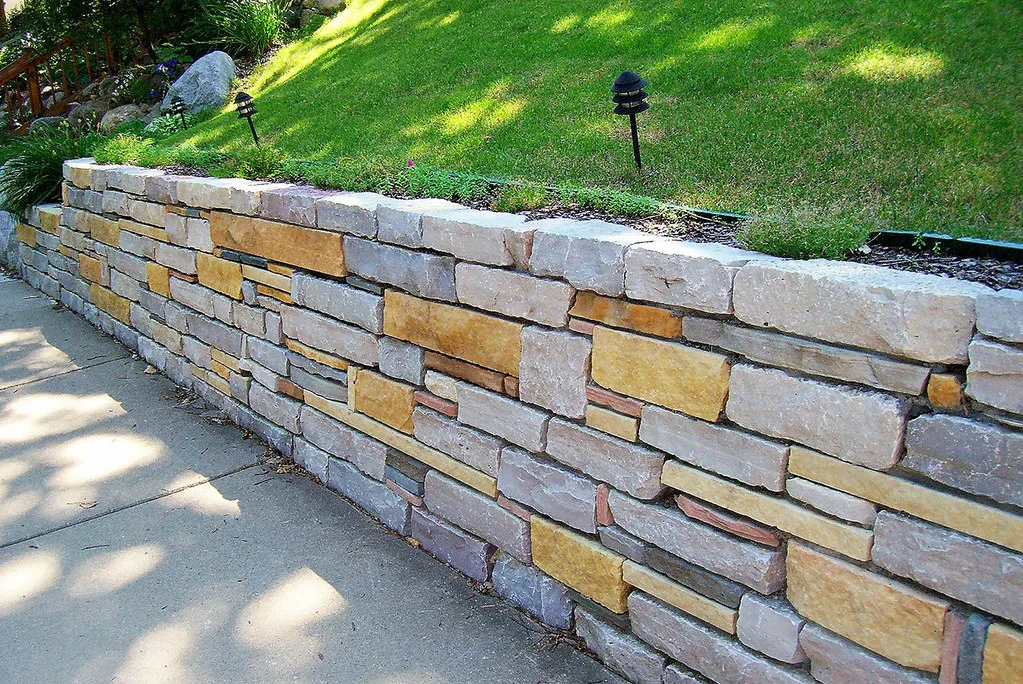
A repair that addresses the cause — instead of just resetting stones or patching a crack — starts with correcting the drainage that caused the problem in the first place. That typically means excavating behind the affected section, installing or repairing weeping tile and free-draining backfill, and only then resetting or rebuilding the section that failed. Skipping the drainage correction and just fixing the visible damage is why some retaining wall repairs fail again within a season or two. The underlying cause was never actually addressed.
When to Call Someone Now vs. When You Can Wait
A wall with only minor cracking, dry behind it, with just yard above , that's genuinely fine to monitor and plan for. A wall that's visibly leaning or bulging, especially with a driveway, building, or pool above it, or a wall where you can see or hear water actively seeping behind it, is worth getting assessed soon rather than waiting for the next freeze-thaw cycle to make the decision for you. When in doubt, our severity check below takes the guesswork out of which category your wall falls into.
The honest answer for your specific wall depends on the combination of what you're seeing, the wall's height and material, the drainage situation, and what's sitting above it. That's exactly what our severity check below is built to assess.
Get Your Free Retaining Wall Severity Check
Answer a few quick questions about your project. Takes about 30 seconds. We serve Simcoe County, Muskoka, and surrounding areas.
Retaining Wall Repair Across Simcoe County & Muskoka
Proudly serving Simcoe County & Muskoka.
How We Price Retaining Wall Repairs
Repair and rebuild pricing depends on the same factors our severity check assesses: how advanced the damage is, the wall's height and material, whether drainage correction is needed behind the wall, and what's above it. We avoid quoting a single flat number for "retaining wall repair" the way some contractors do. It depends entirely on what your specific wall needs.
Our severity check below sorts your wall into a monitor-stage, active-failure, or priority category based on what you're seeing, and gives you a realistic online estimate for that category. A site visit confirms the exact scope and a firm quote before anything is booked.
What Happens If You Ignore a Failing Wall
A retaining wall rarely fails all at once without warning. It's usually a slow progression from a small sign to a bigger one, which is exactly why early attention matters. A crack left unaddressed lets more water into the wall structure and behind it, accelerating both freeze-thaw damage and material degradation. A slight lean left unaddressed tends to increase with each freeze-thaw cycle instead of staying static, since the drainage problem causing it is still there, still adding pressure every winter. What starts as a monitor-and-plan situation can become a priority repair simply by waiting through a few more winters without addressing the underlying cause.
How We Assess Every Wall
Before we quote any repair or rebuild, we assess the wall in person , the material, the extent of movement or damage, what's above it, and most importantly, where the water causing the problem is coming from. That last piece is often the difference between a repair that lasts and one that fails again in a year or two, so we'd rather spend the time upfront finding the actual drainage source than guess.
We understand a leaning or cracking wall can be worrying, especially if you're not sure whether it's cosmetic or structural. Our approach is to walk you through what we're seeing, in plain terms , including telling you when a wall genuinely just needs monitoring, and what to watch for going forward.
Ground Conditions Across Our Service Area
Retaining wall problems look a little different depending on where you are in our service area.
Around Orillia, we see a lot of aging subdivision walls , timber and interlock walls now 25–30 years old and reaching the end of their expected lifespan, along with waterfront walls along Lake Couchiching that deal with additional moisture exposure. One we assessed last year was a timber wall in its 28th season behind a subdivision lot , still standing, but the ties had gone soft enough at the base that resetting it wasn't realistic, and we rebuilt the section in concrete block instead.
In Bracebridge, armour stone walls built into Canadian Shield slopes are common, and the freeze-thaw cycle here tends to be harder on cottage-grade walls along the Muskoka River corridor. Around Huntsville, steep-lot walls are often larger, built with heavier armour stone, and dealing with deeper frost penetration , and remote access on some properties adds logistics to consider when planning repair work.
For more on why walls fail and how to fix drainage before it causes structural problems, see our retaining wall failure guide and our drainage guide. If you want more detail on a specific symptom, we've also written dedicated pages on leaning walls, failure signs, and repair costs.
What Our Clients Say
Our old timber retaining wall in the backyard was leaning pretty badly after last spring's thaw. They came out, explained it was a drainage problem more than anything, and laid out straightforward options instead of just pushing a full rebuild. Repair has held up fine since.
Our armour stone wall was leaning after a wet spring. They fixed the actual drainage problem behind it instead of just resetting the stones, and it's held solid since.
Had cracking in our retaining wall near the driveway. They diagnosed it as a drainage issue rather than something needing a full rebuild, which saved us a lot of money.
Retaining Wall Repair — Frequently Asked Questions
Is a leaning retaining wall an emergency?
It depends on what's above the wall and how far it's leaning. A wall leaning slightly with just yard above it can often be monitored. A wall leaning noticeably with a driveway, building, or pool above it should be assessed soon. The consequences of a failure are much more serious. Use our severity check above to find out where your wall stands.
Why do retaining walls fail even when they look sturdy?
Most failures are a drainage problem wearing on the wall slowly from behind, invisible until the wall finally shows it. Water pooling or seeping behind a wall adds hydrostatic pressure the wall wasn't designed to hold, and repeated freeze-thaw cycles compound the damage every winter. By the time you see leaning or cracking, the underlying drainage issue has often been building for years.
Can a retaining wall be repaired, or does it need to be replaced?
It depends on the extent of the damage, the material, and what's causing it. Early-stage leaning or cracking with a fixable drainage cause can often be repaired without a full rebuild. Walls with significant bulging, partial collapse, or advanced material failure — especially old timber walls near the end of their lifespan — usually need to be replaced rather than patched.
How long do retaining walls last?
It varies by material. Timber and railroad-tie walls typically last 25–30 years before the wood degrades enough to lose structural integrity. Concrete block, interlock, and poured concrete walls last considerably longer when built with proper drainage, though drainage failures can shorten the life of any material.
Find Out Where Your Wall Stands
Every freeze-thaw season a leaning wall waits, the repair gets bigger, find out where yours stands in 30 seconds.
Get Instant Estimate For Your ProjectOr call us: (647) 697-7549